Tapping Into Oil Filter for Pressure Reading
Electric oil pressure level gauges
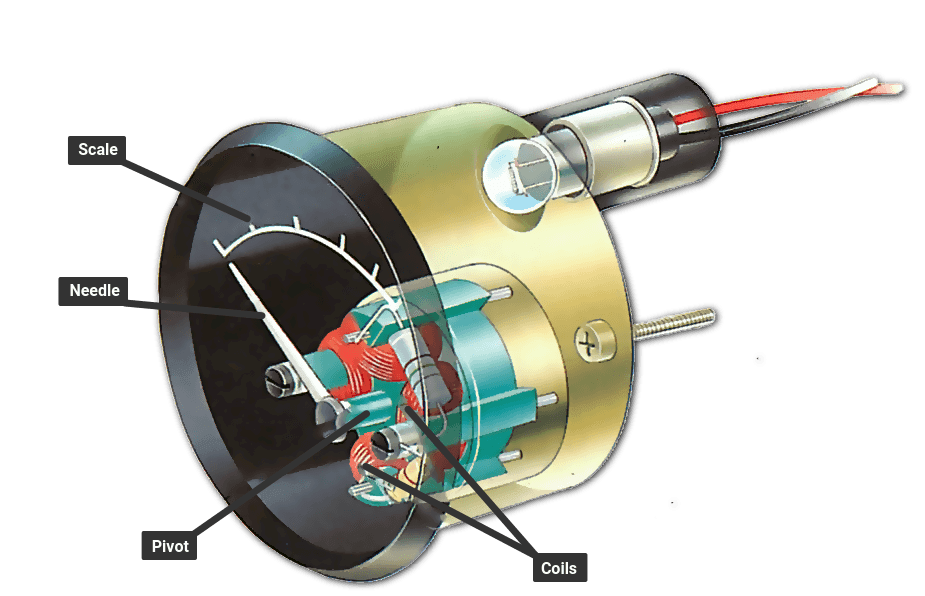
The oil pressure guess is one of the most important instruments in a automobile. It acts as an indicator of the engine 's overall well-beingness and as an early-warning system, giving advance notice of whatsoever problems so you tin investigate the cause before an expensive breakdown occurs.
How oil pressure gauges piece of work
The guess monitors the oil force per unit area in one of the main oilways near to the pump and filter . To do this it has a tapping in the engine block , into which is screwed a sensor (for electric gauges) or an oil pipe take-off (for mechanical gauges).
The sensor for the oil alarm light is screwed into the spousal relationship or T-piece at this indicate, whether or not the automobile is fitted with an oil pressure guess.
Mechanical gauges piece of work by literally forcing the needle effectually the dial under pressure from the engine. Electrical gauges, on the other hand, piece of work past using the sensor screwed into the engine block to produce a variable resistance that affects the amount of electric current passing through the excursion containing the estimate and sensor.
Mechanical gauges
Mechanical oil gauge
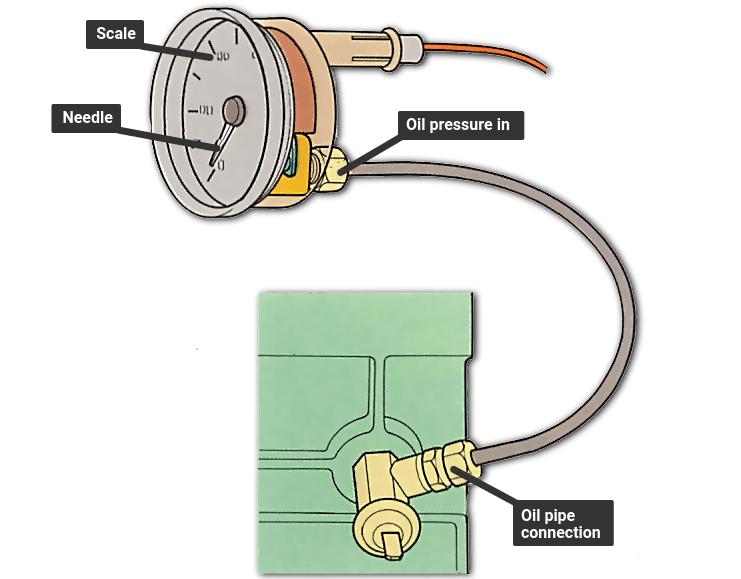
Oil is sent to the approximate from the borer in the engine'due south oilway by a small-bore (3mm) pipe, usually copper or plastic. The piping is routed away from annihilation that could damage information technology, because if the pipage is punctured the engine's oil would leak out.
The pipe enters the passenger compartment via a grommetted pigsty in the bulkhead, and joins the stub on the dorsum of the gauge via a knurled connector.
The estimate contains a flexible coiled tube chosen a bulb, the open terminate of which is rigidly mounted to the gauge's outer casing. The other cease of the bulb is closed and continued by a lightweight linkage to the bottom terminate of the needle, which is itself mounted on a pivot.
Oil is fed into the bulb from the supply pipe at very near the aforementioned pressure as it left the engine. The bulb tries to straighten nether the pressure level and in doing and then moves the needle around the calibrated gauge scale . The greater the pressure, the more the needle moves.
Electrical gauges
Electric sensor units
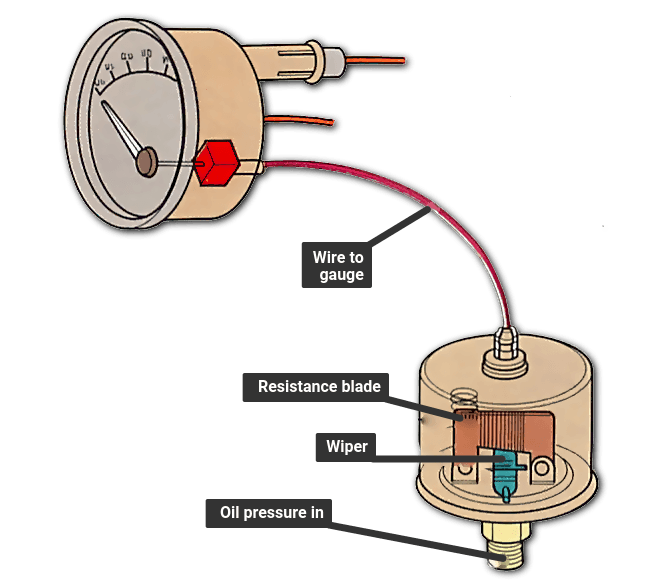
Electric current is supplied to the gauge from a fused ability supply in practice the current is taken from i of the many wires or printed tracks behind the dashboard .
The current passes through a wire-wound whorl mounted around or within the needle's pivot and produces a magnetic field that moves the needle beyond the calibrated scale of the gauge. How far beyond the calibration the needle goes - what reading it gives - depends on how much current flows through the gauge. This in turn depends on the resistance of the estimate'southward return wire which is earthed to the engine block through the sensor.
The resistance of the sensor depends on the oil pressure. Oil enters the end of the sensor which is screwed into the engine cake and pushes confronting a diaphragm . The diaphragm moves a wiper inside the sensor which runs up or down a blade of known resistance this blade is connected to the render wire from the gauge. The more the diaphragm moves under pressure level, the further downwardly the resistance blade the wiper moves. So the resistance of the sensor varies with oil pressure and moves the needle of the gauge appropriately.
All gauges are illuminated so that they can be read at nighttime. Integral gauges are lit from ane of the panel lights which besides illuminate the rest of the instruments, while split gauges have a small-scale (0.5 to 3 watt ) bulb mounted in a holder at their rear. All these lights are unremarkably connected into the side/console low-cal circuit.
Pros and cons
Electrical gauges are easier to integrate into the mod one-piece printed excursion musical instrument panels used in most modern cars, they are less bulky and it'south easier to route and connect a wire than a pipe.
Mechanical gauges are not as common as electric ones, although they are still bachelor in accessory shops. Because the oil arriving at the back of the gauge is at engine pressure, yous take the problem of messy leaks if the pipe comes undone. However, some people find a mechanical gauge more trustworthy.
Oil warning lights
Many cars do not have an oil pressure gauge fitted as standard, just because some indication of low oil pressure (especially zero reading) is so important, they volition at to the lowest degree take a red or orange warning light that shines if the oil pressure level drops below a certain level.
Often this warning light will be connected to an oil-level sensor equally well, and in some cars the low-cal doubles every bit an engine temperature warning light.
stevensfonumene62.blogspot.com
Source: https://www.howacarworks.com/accessories/how-an-oil-pressure-guage-works

Post a Comment for "Tapping Into Oil Filter for Pressure Reading"